Electronic Structure Theory
From quantum mechanics to predictive models of matter.
Every ASESMA edition since the first school in 2010, the core curriculum, regional schools, and open teaching materials.
Every edition brings the school to a new African research community, while teaching materials and collaborations continue to travel.
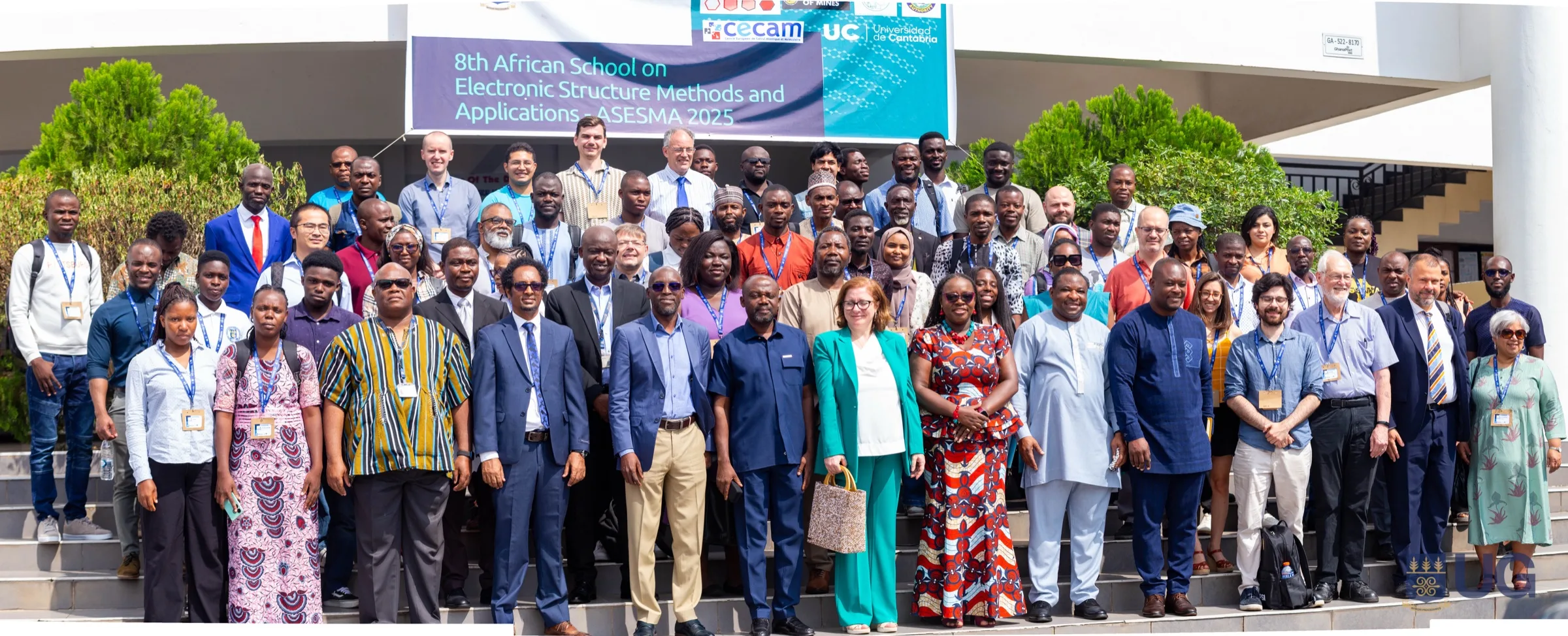
Lecturers, mentors, and participants at the latest biennial school.
Dates, venues, and summaries of every ASESMA school, with links to the official ICTP records.
University of Ghana, Accra, Ghana
9–20 June 2025
View Details →University of Rwanda, Kigali, Rwanda
12–23 June 2023
View Details →Virtual school
31 May – 11 June 2021
View Details →Addis Ababa, Ethiopia
22 October – 2 November 2018
View Details →Accra, Ghana
13–24 June 2016
View Details →University of the Witwatersrand, Johannesburg, South Africa
19–30 January 2015
View Details →Eldoret, Kenya
28 May – 8 June 2012
Cape Town, South Africa
19–30 July 2010
ASESMA concentrates on theory and computational methods for predicting and understanding properties of materials through calculations at the fundamental level of electronic structure.
Every topic pairs rigorous theory with hands-on tutorials using open-source scientific codes.
From quantum mechanics to predictive models of matter.
Ground-state properties, functionals, and practical calculation.
Lattice vibrations and thermal properties of crystals.
Spin-dependent phenomena and magnetic materials.
Enhanced sampling and ab-initio simulations.
Structural, mechanical, and optical behaviour.
Data-driven approaches for materials discovery.
New computational approaches for materials science.
Between the biennial schools, regional schools and focused workshops bring ASESMA teaching closer to more research communities. CASESMA (Central Africa, 2018–2024) and SASESMA (Southern Africa) are part of the wider ASESMA Galaxy.
Lecture notes, tutorials, and codes from ASESMA schools are published openly in the asesma-org GitHub organisation.
Materials from the 2010, 2012, 2014 and 2021 schools are not yet in the GitHub organisation.