Electronic Structure Theory
From quantum mechanics to predictive models of matter.
Endorsed by IUPAP since 2010
A pan-African learning and research network advancing computational materials science through schools, mentorship, and lasting collaboration.
Support the next generation of African scientistsEvery two years, ASESMA brings together students, researchers, and international lecturers for rigorous theory, hands-on computation, and the relationships that sustain research long after the school ends.
Read the ASESMA storyFirst-principles teaching paired with open scientific codes.
A network connecting generations and institutions across Africa.
Capacity built around materials, energy, and emerging technology.
The detailed programme, initiatives, people, and history now have their own focused spaces.
Explore school editions, the core curriculum, open opportunities, and teaching materials.
Meet the regional initiatives, research groups, exchanges, and community channels that form the ASESMA Galaxy.
Meet the committees, international advisors, scientific partners, and institutions behind the programme.
Every edition brings the school to a new African research community, while teaching materials and collaborations continue to travel.
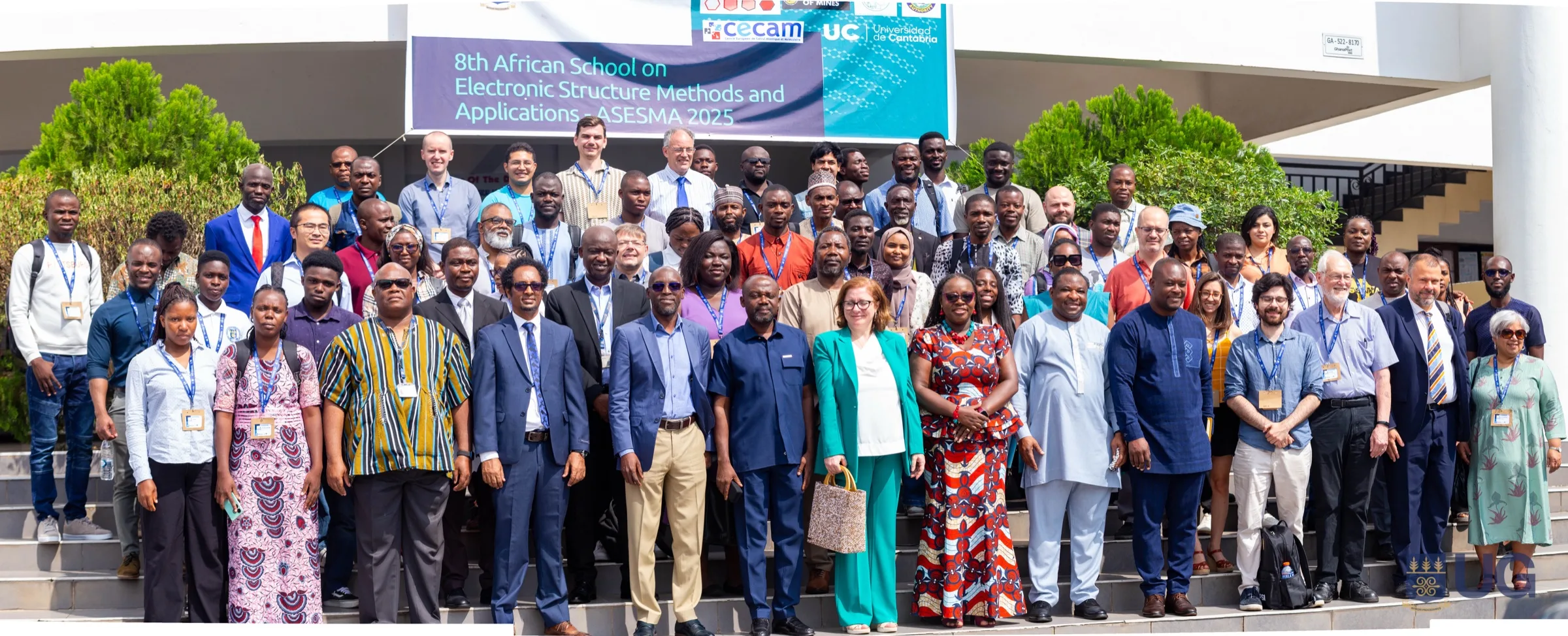
Lecturers, mentors, and participants at the latest biennial school.
Reports, photos, participants, and open teaching materials.
ASESMA concentrates on theory and computational methods for predicting and understanding properties of materials through calculations at the fundamental level of electronic structure.
Every topic pairs rigorous theory with hands-on tutorials using open-source scientific codes.
From quantum mechanics to predictive models of matter.
Ground-state properties, functionals, and practical calculation.
Lattice vibrations and thermal properties of crystals.
Spin-dependent phenomena and magnetic materials.
Enhanced sampling and ab-initio simulations.
Structural, mechanical, and optical behaviour.
Data-driven approaches for materials discovery.
New computational approaches for materials science.
Independent, coordinated activities extend ASESMA beyond the biennial school—linking regional programmes, research groups, and international collaborators.
 The shared core
ASESMA
The shared core
ASESMA
Central African School on Electronic Structure Methods and Applications, operating from 2018–2024 across Dschang (Cameroon), Brazzaville (Congo), and Kinshasa (DR Congo).
The Atomistic Simulations, Electronic Structure, Computational Materials Science and Applications network functions as a continental research network.
The US-Africa Initiative for Electronic Structure fosters transatlantic collaboration in computational materials science.
Short-format educational content (20 minutes plus discussion) delivered regularly to extend learning beyond the biennial school.
Specialized virtual teams focusing on many-body perturbation theory, catalysis research, and other advanced topics.
Selected African scientists visit partner institutions globally, including Fudan University (China) for collaborative research.
Upcoming events will be announced soon.
The teams guiding ASESMA's long-term direction, school planning, and international scientific network.
Provides strategic leadership and continuity across the ASESMA programme.
International Centre for Theoretical Physics, Italy
University of Ibadan, Nigeria
University of Yaoundé I, Cameroon
University of Ghana, Ghana
École Polytechnique, France
Jawaharlal Nehru Centre for Scientific Research, India
Rutgers University, USA
University of Illinois Urbana-Champaign, USA
Coordinates the scientific programme, teaching activities, and delivery of future schools.
École Polytechnique, France
University of Johannesburg, South Africa
Covenant University, Nigeria
University of Cantabria, Spain
University of Duisburg-Essen, Germany
Addis Ababa University, Ethiopia
Paul Scherrer Institute, Switzerland
Distinguished scientists who advise ASESMA and strengthen its international partnerships.
ASESMA is sustained by a long-standing community of scientific, institutional, and funding partners.
The Center for Computational Quantum Physics (CCQ) anticipates several postdoctoral-level appointments in 2027, and welcomes candidates with a demonstrated interest in computational approaches to the quantum many-body problem in all its different forms. Flatiron Research Fellows develop the new concepts, algorithms and codes needed to understand the many-particle quantum problem, and study the physical and chemical properties of systems that require this new understanding.
A parallel track at CCQ for researchers more directly aligned with the centre’s software and coding efforts, building and maintaining the open scientific software that underpins its work on the quantum many-body problem.
Applications are reviewed from Fall 2026 and considered on a rolling basis until the positions are filled. The Simons Foundation provides equal opportunities to all applicants without regard to race, religion, colour, age, sex, pregnancy, national origin, sexual orientation, gender identity, genetic disposition, neurodiversity, disability, veteran status, or any other protected category under federal, state and local law. Enquiries may be addressed to Antoine Georges (Director, CCQ) and Andrew Millis (co-Director, CCQ).
Connect with the ASESMA community and access teaching materials from past schools.
Browse lecture notes, tutorials, and codes from all previous ASESMA schools. Everything is open and publicly available.
github.com/asesma-org →Join the ASESMA community on Slack — connect with past participants, share research, and stay informed about upcoming events.
Request access →An ASESMA LinkedIn page is coming soon — a space for past participants and the broader community to connect.
Coming SoonApplications are now open for the 8th African School on Electronic Structure Methods and Applications at the University of Ghana, Accra.
ASESMA runs every two years. Register your interest and we'll reach out when the next school opens for applications.